Small Talk 28 - Surrealism
When you witness something bizarre or unbelievable, how do you describe it? Let's say you click a headline about an event that would have been unimaginable ten years ago—when you read the story, what word comes to mind? Quite possibly, you think, ‘This is surreal.’ I often do. But I'm always left with a sense that I'm not quite using the term correctly. That there's a more suitable word just beyond grasp. So, since the term surreal seems apt more and more every day, let’s get to the bottom of it. This week's Small Talk is about: Surrealism.
Surreal is a relatively new word, emerging in the early 1900s. So for example, when Mount Tambora erupted in 1815, releasing so much volcanic ash into the atmosphere that global temperatures dropped and crops failed—no one said, 'This is so surreal.' Even though it must have been. Because the term had not been coined. 100 years later, in 1917, the French poet Guillaume Apollinaire, looking for a better way to describe the work of Jean Cocteau, introduced the term surrealism. Or more precisely, the French word surréalisme, which combines the words for 'beyond' and 'realism.'
Soon after, the term was adopted by a group of artists, mostly in Europe, who founded the Surrealist art movement. Names for art movements are funny, because sometimes they're accidental or even critical. 'Fauvists' was originally an insult, meaning 'wild beasts,' in French, because these artists dared to paint with unreal colors. Even 'Impressionism' was originally a slight, but Monet and his peers cheerfully accepted it. The Surrealists, however, really wanted that appellation. Theirs was a very deliberate school of thought. So much so that they had their own manifesto! In 1924, the poet André Breton published the Manifesto of Surrealism, which advocated a liberation of the mind from logic and reason, and emphasized the subconscious and dreams as a path toward a new reality and artistic vision.
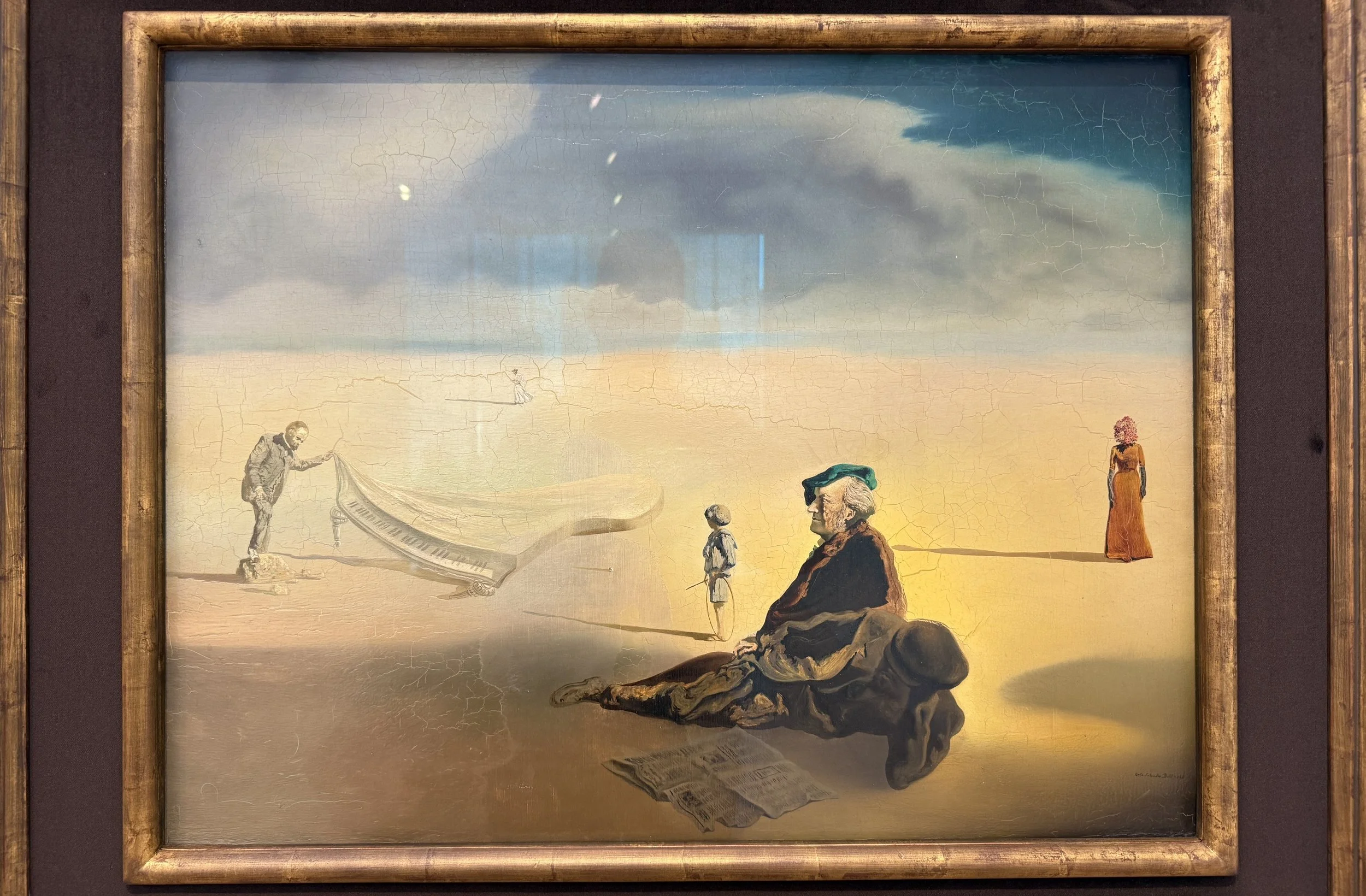
That's right, a poet. When you think Surrealism, you’re probably picturing paintings, especially those by Salvador Dalí . (At the top of this page you'll see his painting A Chemist Lifting with Extreme Precaution the Cuticle of a Grand Piano, 1936, courtesy of The Art Institute of Chicago.) But Surrealism's self-appointed leader was a poet, and his manifesto, which numbered 12,784 words, was mostly focused on words, and writing as an expression of surrealism.
The Manifesto of Surrealism is an entertaining read. It includes an episode where Breton, just before sleeping, is struck by the phrase "There is a man cut in two by the window," which inspires him to invite his friend Philippe Soupault to 'blacken some paper,' writing automatically and instinctively more than fifty pages together. When they compare their results, they are remarkably similar! The manifesto also veers into surrealism itself, ending with the lines...
"You are no longer trembling, carcass. This summer the roses are blue; the wood is of glass. The earth, draped in its verdant cloak, makes as little impression upon me as a ghost. It is living and ceasing to live which are imaginary solutions. Existence is elsewhere."
But Breton's manifesto is also quite didactic. Here is the nut:
"Those who might dispute our right to employ the term SURREALISM in the very special sense that we understand it are being extremely dishonest, for there can be no doubt that this word had no currency before we came along. Therefore, I am defining it once and for all:
SURREALISM, n. Psychic automatism in its pure state, by which one proposes to express -- verbally, by means of the written word, or in any other manner -- the actual functioning of thought. Dictated by the thought, in the absence of any control exercised by reason, exempt from any aesthetic or moral concern.
ENCYCLOPEDIA. Philosophy. Surrealism is based on the belief in the superior reality of certain forms of previously neglected associations, in the omnipotence of dream, in the disinterested play of thought. It tends to ruin once and for all all other psychic mechanisms and to substitute itself for them in solving all the principal problems of life."
Breton liked to make lists that named artists he considered legitimately surrealist. The manifesto names many from the past, like Swift, Poe, and Rimbaud. He also maintained a list of which of his contemporaries were surrealists. It was a bit of gatekeeping, to be honest, as artists were drawn in and cast out of the surrealist club based on Breton's whims. By the mid-1940s, surrealism as a formal movement had disintegrated, with its most famous artists, like Dalí , breaking from Breton. But the influence of the surrealists lives to this day.
Art historians point out that the surrealists were especially influenced by two factors. The first was World War I, by far the most brutal and violent war to date. The horrible carnage of trench warfare and modern weapons left many doubting the merit of humanity. The Dada art movement, which arose during the war, reacted to these doubts—the dadaists believed that civilization had become so corrupt it must be swept away, including its traditional art. Works like Duchamp's 'sculpture' of a urinal, or painting a moustache on the Mona Lisa, were an attempt at demolishing old conventions. They were a bit punk rock. The surrealists built on dadaism, also embracing a departure from norms, but proposing more creative and exploratory art. Sort of psych rock, you might say.
Modern psychology was the second major influence on surrealism, specifically the unconscious and the theories of Sigmund Freud. Surrealists sought to capture the world of dreams, exploring the idea that the unconscious is the more true and authentic state of being—where the waking, rational mind is untrustworthy (aka, sus).
Let's talk about some painters. I suspect that Salvador Dali's The Persistence of Memory (melting clocks) is the most well-known surrealist painting. And it is pretty great. René Magritte's work is more ordinary and clean in style, but legendary for mystery and illusions. A train emerging from a fireplace, a man with an apple floating in front of his face, a painting of a pipe labeled Ceci n'est pas une pipe (get it, it's a painting, lol). Max Ernst is a good one to look up. Also Meret Oppenheim, who demonstrates the surrealist practice of combining things in an incongruous way (most famously, a fur-lined cup and saucer) as a way of shaking the observer out of their reality-induced stupor. Other surrealists to check out: Frida Kahlo, Dorothea Tanning, Joan Miro, Leonora Carrington.
You've probably read some surrealist writers, and seen some surrealist movies. Although it was written before the term, Alice's Adventures in Wonderland is definitely surrealist. And then there's Kafka. Among contemporary surrealist authors, one of my favorites is Haruki Murakami. Yorgos Lanthimos makes award-winning surrealist films, including Poor Things and last year's excellent Bugonia.
What we are arriving at is the realization that surrealism is all around us, and extends into the past, and will likely continue into the future. We humans have a compulsion to look for meaning beyond what our everyday senses tell us. Surrealism is a form of escape, when shit gets too real. But it's also a form of liberation, of rejoicing in our imaginations, returning to the wonder of childhood.
I'm left with two final thoughts. First, that surrealism may be devalued these days, thanks to AI-based creation tools. When a politician makes a picture of himself being Jesus, that is kind of surreal, but it's also cheap. You can make machines make weird pictures all day long, burning cycles in remote data centers, stirring sniggers from distracted friends, but ultimately this practice skips the journey of making art. And without that journey, you might argue, art is meaningless.
The second thought is that, when we bring our full attention to the world around us, we discover something much more amazing than what our unconscious can produce. Look at a tree, leafing out here in the north, and consider all that's involved in sprouting just one leaf. That is very strange and wonderful. In fact, it's surreal.
Have a good one,
Kipling Knox
P.S. This was a fun piece to research, and it took me through all sorts of looking glasses and down many rabbit holes, but one documentary stands out as particularly insightful, deliciously dated, and in itself surreal. If you're interested in this subject and have a free hour, see Karl Krogstad's Surrealism.
You might also like: Magnetism and Happiness
See all Small Talks here and share them with your friends!